
Warehouse safety systems should not depend on the weakest part of the building.
In many facilities, that weak point is the network.
Corporate Wi-Fi may be good in the office and unreliable in the racking. It may work near the breakroom and drop near dock doors. It may support laptops and phones but struggle with moving forklifts, handhelds, sensors, and autonomous equipment in difficult RF conditions.
That is a problem when safety depends on real-time awareness.
A forklift, cobot, or autonomous mobile robot does not wait for a network retry. A worker stepping out of an aisle does not wait for a dashboard refresh. A collision avoidance alert cannot be delayed because a device moved through a dead zone.
Safety has to work locally.
That is the principle behind ECHO SLAM.
The floor is becoming more complicated
Warehouses are no longer just people, pallets, and forklifts.
Many operations now include autonomous mobile robots, collaborative robotics, conveyor automation, lift trucks, pallet movers, scanners, wearable devices, and temporary labor moving through the same spaces.
That creates a harder safety environment.
The risk is not only that a vehicle may hit a person. The risk is that people and machines are sharing more of the same floor, with more movement and less margin for error.
Traditional safety approaches tend to be reactive. Cameras record what happened. Buzzers make noise. Signs warn people to be careful. Training tells everyone to stay alert.
Those tools have a place. But they do not create a real-time protection layer around the worker.
Why network-dependent safety is fragile
A proximity alert that depends entirely on backhaul connectivity has a built-in weakness.
If the device loses Wi-Fi, what happens?
If the corporate network is congested, what happens?
If the forklift moves into a dead zone, what happens?
If IT changes something upstream, what happens?
If a switch, AP, or authentication system has a problem, what happens?
For operational dashboards, a delay may be annoying.
For safety, a delay can be unacceptable.
That is why ECHO SLAM is designed so the local collision avoidance alert does not depend on the network being available.
What ECHO SLAM does differently
ECHO SLAM is the worker safety layer inside the broader ECHO for Logistics solution.
It uses 360° UWB, radar, and BLE proximity tracking to help detect worker-to-vehicle and worker-to-equipment risk. The system supports graduated alerts: softer warnings at distance and stronger alarms when a worker and vehicle are too close.
The important point is local operation.
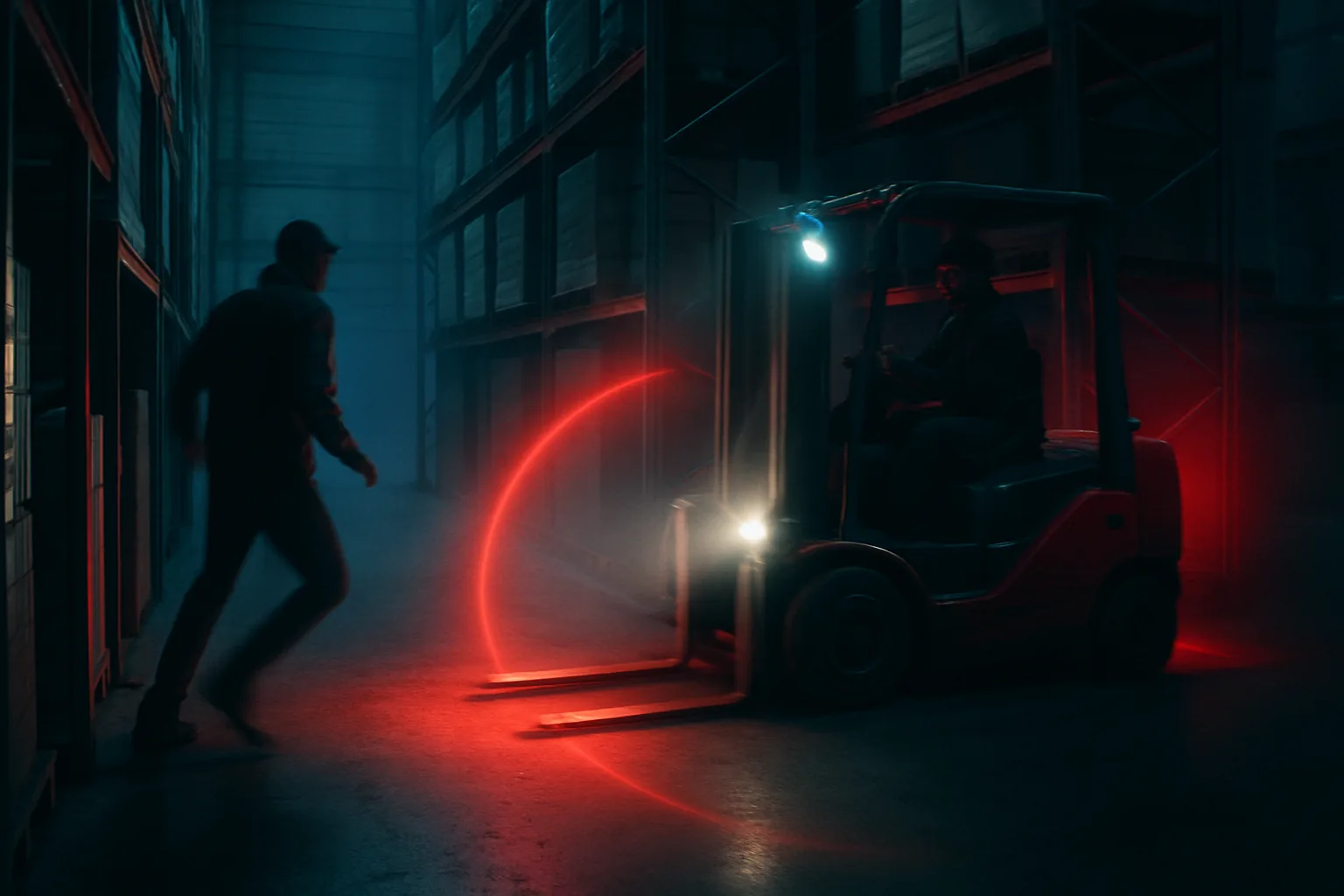
If a forklift or autonomous machine comes close to a worker, the alert should happen right there, at the edge, without waiting for a cloud round trip or a corporate Wi-Fi connection.
That does not mean the network is unimportant. The broader ECHO system still uses owned private wireless infrastructure to provide visibility, logging, management, and the operational digital twin.
But the safety event itself has to be immediate.
Local safety plus live visibility
The strongest model is not local safety or network visibility. It is both.
Local alerting protects the worker in the moment.
The private wireless network supports broader visibility.
The digital twin shows where risks are emerging.
The managed device lifecycle keeps equipment configured and supported.
The operational record helps supervisors understand patterns over time.
That is how ECHO connects the digital worker and the digital twin.
The worker is protected locally. The operation still gains a live view of safety activity across the facility.
The operator takeaway
If a safety system only works when the network is perfect, it is not built for the real warehouse floor.
ECHO SLAM is designed around the opposite assumption: the alert has to work locally, because the moment of risk happens locally.
Private wireless still matters. Managed devices still matter. RTLS and the digital twin still matter. But collision avoidance cannot be treated like a normal software notification.
It has to be fast.
It has to be close to the worker.
It has to keep working when the rest of the network is having a bad day.
That is the right foundation for frontline safety.