
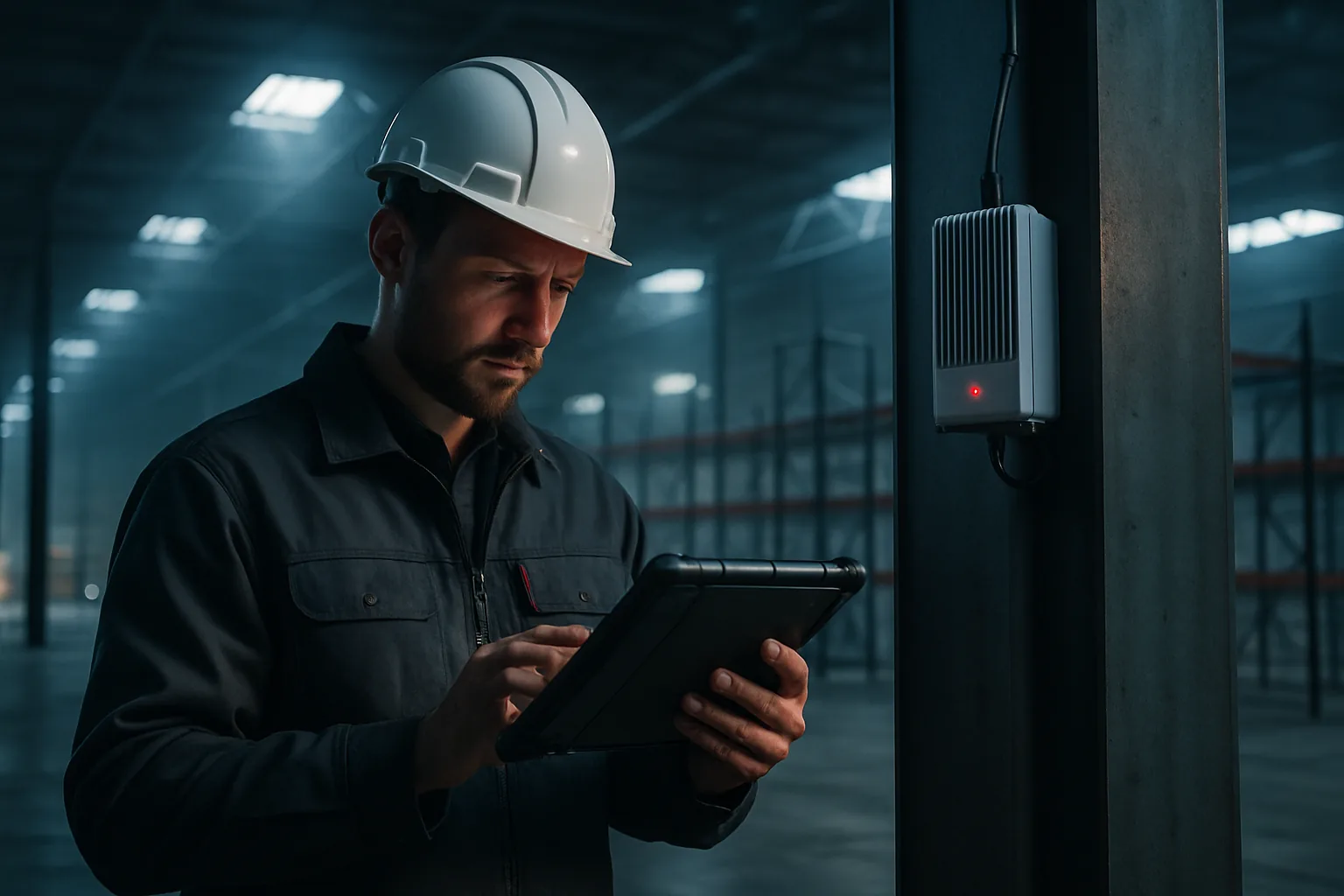
A modern WMS can have a clean API, a polished dashboard, and a long list of integrations. That still does not mean it works reliably on the warehouse floor.
The problem is not always the WMS.
In many warehouses, the software layer is expected to perform on top of a physical environment it does not control. Workers scan inventory inside metal racking. Forklifts move between indoor and outdoor zones. Tablets and handhelds roam through dead spots. Yard teams move beyond the comfortable reach of the building Wi-Fi. Then someone wonders why the “real-time” inventory view is not really real time.
That is where many software-first warehouse projects stall. The API may be ready. The workflow may be mapped. The system may be capable. But the actual edge devices feeding the system are still dependent on shaky coverage.
A warehouse API is only as good as the physical data path underneath it.
The floor is where the integration either works or fails
Most WMS integration discussions happen at the software layer. API endpoints. Middleware. Data formats. Authentication. Sync logic. Error handling.
Those pieces matter. But they are not the whole system.
The real test is what happens when a worker scans a pallet in a bad coverage area.
What happens when a rugged tablet drops connection near the dock doors?
What happens when a forklift-mounted device loses signal between rack rows?
What happens when a yard worker is outside the building and cannot reliably update a move?
Those are not abstract IT problems. Those are operational problems.
A missed scan becomes manual reconciliation. A delayed inventory update becomes a bad pick decision. A disconnected worker creates a gap between what the WMS thinks is happening and what is actually happening.
That gap is exactly what ECHO for Logistics is built to close.
The ECHO view: integration starts with owned infrastructure
ECHO does not treat warehouse integration as a software-only exercise.
The private wireless network is the physical foundation. Managed rugged devices are the execution layer. Custom applications and use cases are the operational layer. Together, they create one solution that can support the digital twin and the digital worker at the same time.
That is the important distinction.
ECHO is not simply “a private network.” It is also not just a device program or a dashboard. The point is to unify the network, the devices, and the warehouse use cases so the operator has one live operational model instead of disconnected pieces.
For WMS workflows, that means inventory adjustments, scan events, exception handling, location updates, and worker actions can ride on a network designed for the floor rather than borrowed from the office.
Why CBRS private wireless changes the conversation
Warehouses are hard RF environments. Metal racks, long aisles, moving equipment, concrete, dock doors, cold storage, and outdoor yards all make coverage difficult.
Private wireless using CBRS Band 48 gives the operator a more controlled foundation for industrial connectivity. Instead of hoping corporate Wi-Fi reaches every aisle and yard corner, the facility can be surveyed, designed, and managed around operational coverage requirements.
The result is not just “better signal.” The result is more control.
Control over coverage.
Control over device access.
Control over priority.
Control over segmentation.
Control over how operational data moves.
That matters when the WMS depends on floor events being captured at the moment they happen.
A real WMS ecosystem needs live floor truth
The future of warehouse systems is not just API connectivity between software platforms. It is live floor truth.
Where is the worker?
Where is the forklift?
Where is the pallet?
Which zone is congested?
Which device is offline?
Which cold-chain area is drifting?
Which scan failed because the device lost connection?
A WMS cannot answer those questions by itself. It needs reliable physical inputs from the facility.
That is why ECHO frames the outcome as a live digital twin, not just another integration. The digital twin is the operational model created when floor data flows continuously from connected workers, vehicles, sensors, and devices.
The operator takeaway
An API-first WMS is a good thing. But it is not enough by itself.
If the warehouse floor still has dead zones, disconnected handhelds, dropped scanner sessions, and manual workarounds, the integration is not finished. It is just sitting on an unstable foundation.
ECHO for Logistics starts at the foundation: owned private wireless infrastructure, managed devices, and use cases built around the way the operation actually runs.
Because the best WMS integration is not the one that looks clean in a diagram.
It is the one that still works in the racking.